Final Year Project
Empowering Smoke Quitters Through Psychological Resilience
AIA Award-Winning Smoking Cessation Solution
Role
Design & UX Research
Team
Kelvin Fong
Year
2025
Project Type
School Project


Overview
Smokend is a smoking-cessation concept exploring how behavioural design can support people through the psychological challenges of quitting. The system combines a mobile app, a detachable wearable, financial commitment, visible progress, and support from a trusted person. Together, these elements explore how users might prepare for cravings, respond during difficult moments, and maintain motivation over time.
Starting Point
Many of us have heard friends or family say, "I'm going to quit smoking," only to see them relapse weeks or months later. It made us wonder: if people genuinely want to quit, why is it so difficult to resist the urge on their own? We discovered that existing cessation tools address nicotine withdrawal, but fail to tackle the deeper barriers: the psychological rituals, social isolation, and invisible progress that quietly erode motivation and cause relapse. This question became the starting point of our design process.
Looking for Answers
We interviewed smokers, surveyed people with experience of quitting, consulted a smoking-cessation expert, and reviewed existing research. Each method helped us examine a different part of the journey: what people were trying to change, what made cravings difficult to manage, and what affected their motivation over time.
67
📝 Surveys
15
💬 Interviews
2
🎓 Expert Interviews
20 ~
📃 Literature Review


Problems
After conducting several interviews and some research, we found a number of insights and problems that are actually making the quitting process much more difficult.
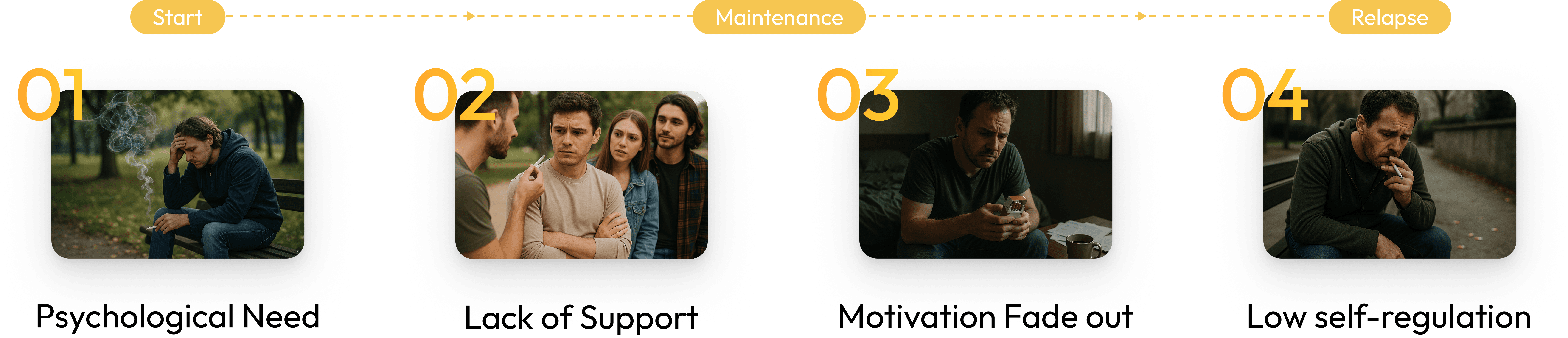
Smoking fulfils more than nicotine
For many participants, smoking was part of a daily routine. It created a way to manage stress, take a break, or connect with other people. Quitting therefore meant replacing a familiar psychological ritual, not only overcoming physical cravings.
Quitting can feel like a lonely journey
Without consistent support, participants struggled to stay committed. Social pressure and the experience of quitting alone made it much harder to resist temptation, especially during difficult moments.
Motivation fades when progress isn't visible
Participants could not clearly see how far they had come. Without visible progress, their motivation declined, and staying committed became harder over time.
Triggers are impossible to avoid completely
Participants could try to remove cigarettes and avoid certain situations, but everyday triggers were still difficult to control. Seeing someone smoke or returning to a familiar social setting could bring back a craving even when the intention to quit remained strong.
Persona
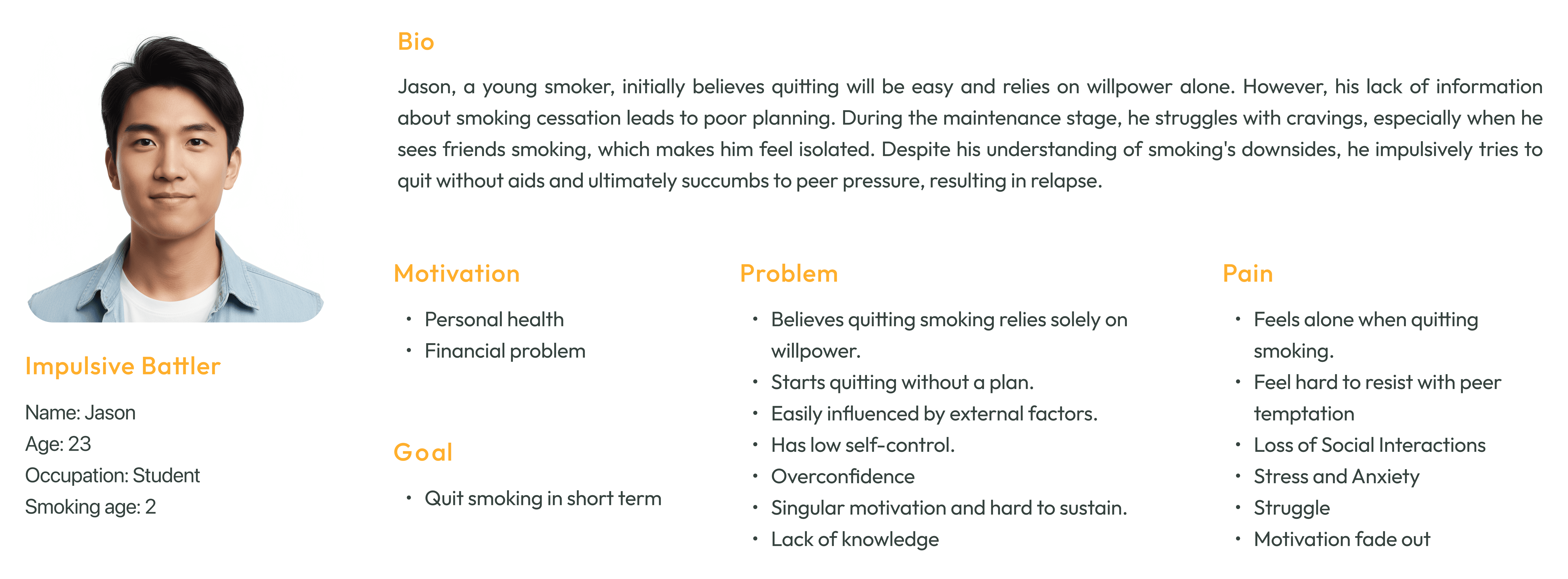
How might we provide timely support that kept quitters motivated throughout their journey?
How might we help quitters manage cravings when triggers are unavoidable?
Design exploration
We explored several ways to respond to these challenges, beginning with an avatar-based concept that used game mechanics to support quitting.


First Prototype

Gamification
Guides users through calming breathing exercises during moments of stress. This helps interrupt cravings before they become automatic.
Support & Commitment
Quitting smoking is often easier with support, so we make it a two-person effort instead of a solo one. The supporter provides encouragement, accountability, and motivation by tracking the quitter’s carbon monoxide and stress levels.
Breathing exercise
A detachable wristband becomes a breathing stick to help ease cravings. It prompts breathing exercises based on stress and detects carbon monoxide when users breathe into it.
Feedback from tester
“I think the fire character may be somewhat useful, but it still can’t provide enough motivation.”
P1“Personally, I’m not very fond of games, but I believe the character’s evolution can help visualize one’s smoking cessation journey and serve as encouragement.”
P2“I can imagine some people might enjoy the nurturing aspect, but for myself, I think it may not be effective in providing a sense of achievement.”
P4What to keep, remove, or change
Keep
Breathing exercises effectively relieved cigarette cravings.
Supporter commitments helped motivate and sustain smoking cessation.
Remove
Raising an character through gamification may not sustain motivation, as it lacks a strong emotional connection for quitters.
Iterative refinement
What should we do to further help the user feel connected to their goal?
Is it possible to further develop their internal motivation?
Design Iteration
Testing showed that avatar-based rewards were not creating a strong enough sense of motivation. We therefore shifted towards psychological resilience, focusing on commitment, visibility, and social support.

User testing showed that avatar rewards weren't working well. We changed to a financial commitment approach where users invest financially in their quit journey. This taps into loss aversion—people hate losing money they've already put in. The change was based on direct user feedback, and one participant remained smoke-free for all 20 days of testing.
How financial commitment works?
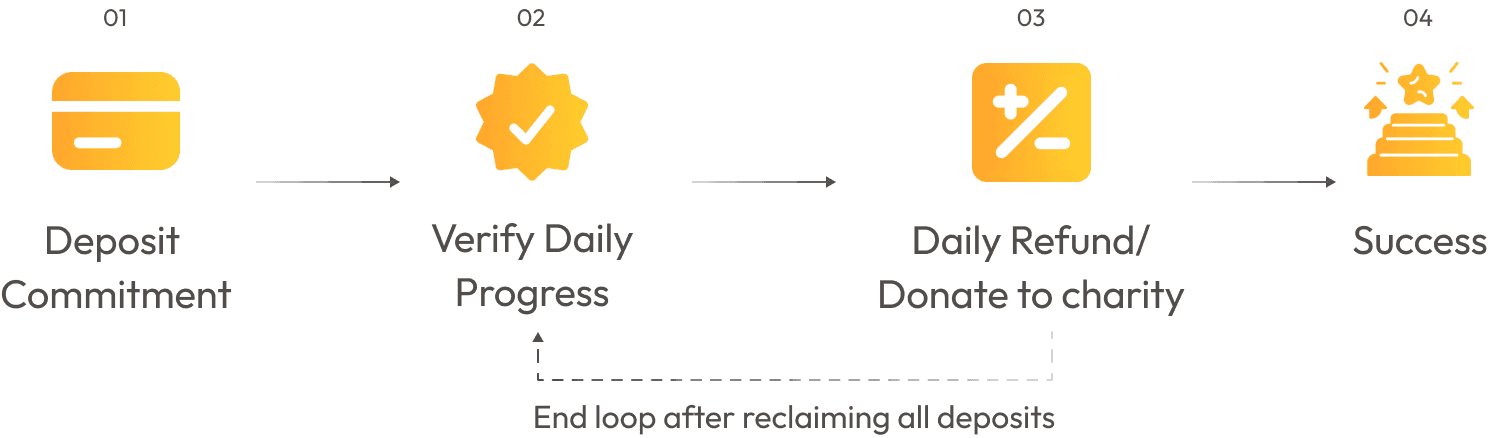
For these situations, we are trying to create a feedback loop that enhances smokers’ psychological resilience. This is based on the behavioural science concept of loss aversion, as people tend to try to avoid losing something. That is why we implemented this financial commitment system: when users smoke, they lose their money, which is then donated to charity. On the other hand, if they can keep staying smoke-free, they receive a daily refund, which makes them feel as though they are making progress.
Validation
Before committing to the financial mechanism, we simulated it through PayMe to compare how participants responded to deposits, refunds, and visible progress. The test was designed to explore whether financial commitment created a stronger sense of motivation than the earlier avatar concept.

Testing Method
We simulated the financial commitment system using PayMe. Participants deposited money, and smoke-free milestones triggered partial refunds. We observed how they responded to the deposits, refunds, and progress feedback.
Insights We Found
Longest quit attempt
The participant remained smoke-free for all 20 days, exceeding previous quit attempts.
Refunds felt like rewards
Daily refunds were perceived as "new money," reinforcing progress despite coming from the participant's own deposit.
Frequent reinforcement increased motivation
Daily refunds strengthened the participant's identity as someone actively quitting smoking.
Personalisation is important
The deposit amount should be tailored to each person's financial situation to remain meaningful.
From validation to the final system
Our testing confirmed that meaningful consequences and frequent feedback created stronger motivation than avatar-based rewards. However, quitting is not only a long-term motivation problem. Users also need support at the exact moment a craving occurs.
This led us to define SMOKEND as a three-part behavioural system:
Commit: users set a personal goal and make a financial commitment.
Respond: the wearable detects moments of stress and offers an immediate alternative to smoking.
Reinforce: the app makes health, financial, and personal progress visible while involving a trusted supporter.
Together, these elements help users manage the immediate craving while continuing to invest in their longer-term identity as a quitter.
The final design direction

The final system combines a detachable wearable with a companion app. The wearable provides immediate support during cravings, while the app reinforces commitment through visible progress, personal goals, and social accountability.
Final Design

On-Wrist Support
The wearable exists to provide timely support during moments that matter.

Breathing Exercise
Because cravings often appeared during moments of stress, the wearable offered a guided breathing exercise at the point of need. This gave users an immediate alternative to smoking when they encountered a craving.
Stress Detection
Recognises signs of increased stress and prompts timely support, helping users manage cravings before they become overwhelming.
Carbon Monoxide Monitoring
Shows improvements in carbon monoxide levels as users stay smoke-free, providing visible progress that reinforces motivation and long-term commitment.
Bringing the Strategy to Life

Financial Commitment
Quitters deposited money before beginning their journey. Smoke-free days earned partial refunds. Relapses sent deposits to charity. Escalating penalties kept the stakes meaningful over time, turning cigarette money into daily motivation.
Progress Tracking
Participants told us that invisible progress made it difficult to stay motivated. The Home Screen therefore made both smoke-free days and reclaimed money visible, turning gradual progress into something users could see and feel each day.


Supporter Feature
Since quitting could feel lonely, we introduced a supporter feature that turned private progress into a shared commitment. A trusted person could follow the journey and validate smoke-free milestones, providing accountability beyond the app itself.
Diary
Users reflected on their progress, tracked emotional patterns, and documented milestones. The feature helped quitters see quitting as an identity they were building, not just a habit they were breaking, thereby enhancing their internal motivation alongside their financial commitment.

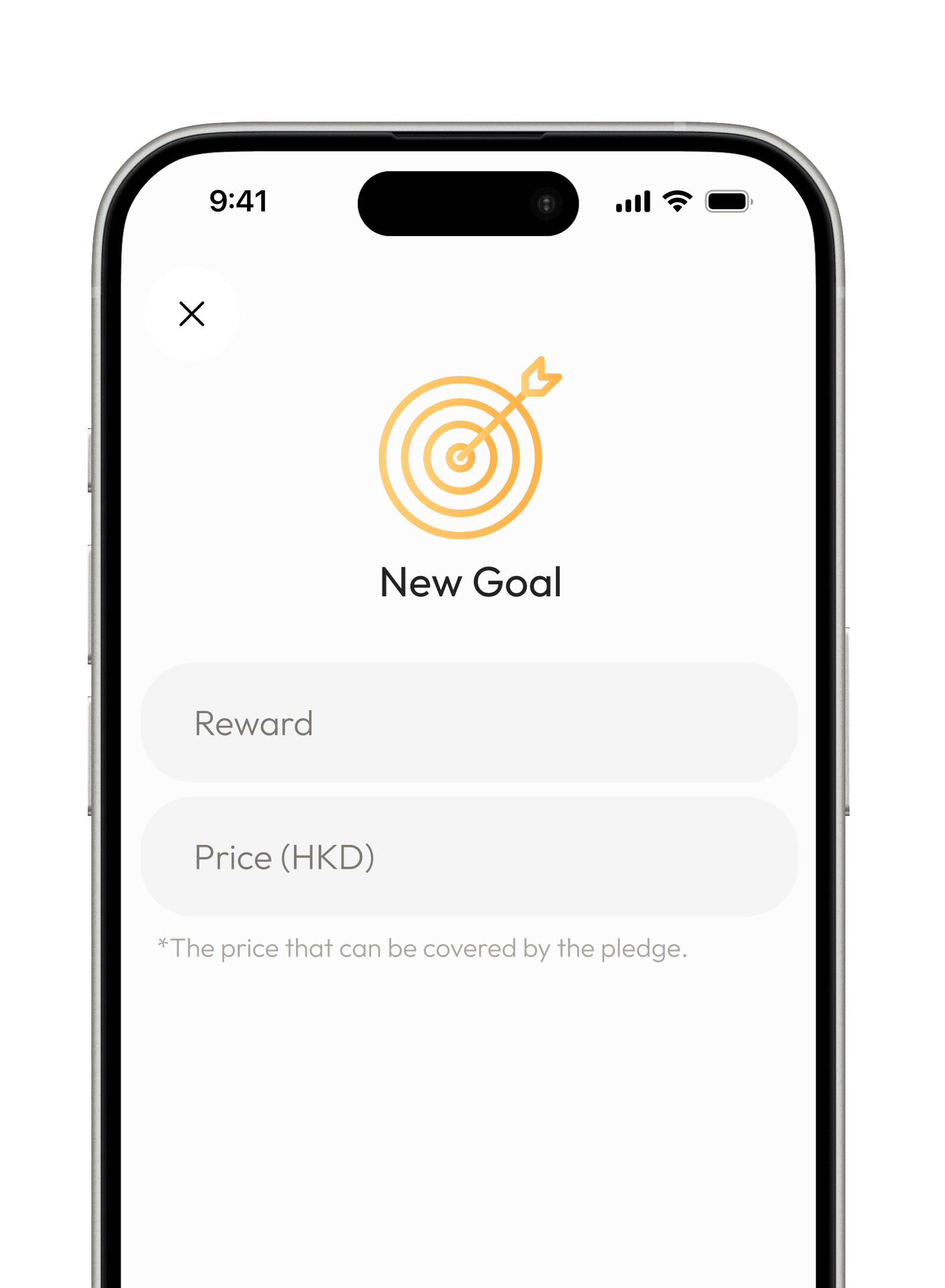
Customized Goal
The customised goal feature lets users set personal rewards—enter an item and its price, then save towards it and cash out the deposit when the goal is reached. The PayMe test showed that saving towards a specific, self-chosen item created stronger motivation than receiving a generic cash refund.
Demo
We presented the final concept to the AIA design team

Reflection

The right mechanism matters more than engagement tricks
Behavioural design is not about making experiences fun — it is about aligning the right psychological mechanism with the user's real goal. Financial commitment worked because it connected daily action to a tangible consequence.
Fail early to find what not to build
The avatar concept failed in testing, and that failure saved us from investing in the wrong direction. Early prototypes are most useful when they reveal what the solution should not be.

