


Cooperative Project
Role
Design & UX Research
Team
Kelvin Fong
Daniel Tsang
Year
2024
Project Type
School Project
Overview
SwiftFresh is a service concept developed in collaboration with SF Express at The Hong Kong Polytechnic University. It explored how fresh food and health-focused shopping could become more accessible for residents living on Hong Kong’s outlying islands.
Rather than treating drone delivery as the final answer, we used it as part of a broader service strategy. Our goal was to design an experience that could work within the realities of island living, while still feeling practical, useful, and grounded in real user needs.
Target Audience
The research focuses on residents of Hong Kong's outlying islands—Cheung Chau, Peng Chau, and Lamma Island—to understand how drone delivery technology can enhance their daily life.

For many residents, buying fresh ingredients is not just a matter of convenience. It is shaped by ferry schedules, transport costs, supply limitations, and the extra effort needed to shop outside the island. SwiftFresh was designed with these realities in mind.
Research Method
To understand the problem more clearly, we combined quantitative and qualitative methods. We conducted 56 surveys, 15 face-to-face interviews, and 4 on-site visits with residents of Cheung Chau, Peng Chau, and Lamma Island.
56
📝 Surveys
15
💬 Interviews
4
🏝️ Site Visits
The surveys helped us understand which products were most affected by limited supply and higher prices. The interviews gave us a deeper view into daily routines, shopping behaviour, and the trade-offs residents make when choosing where and how to buy food. The site visits helped us observe the island context directly and understand how geography influences shopping decisions.
Together, these methods helped us move beyond assumptions. Instead of treating the issue as a simple delivery problem, we began to understand it as a broader access problem shaped by location, time, cost, and lifestyle goals.
Survey Findings
Fresh food was the most commonly reported category affected by both limited availability and higher prices, suggesting that food accessibility should become the primary design focus.
Food食品
75.1%Daily Necessaries日用品
30.4%Electronics電子產品
26.8%Medical Supply醫療用品
23.2%Multi-select surveyn = respondents
Problems
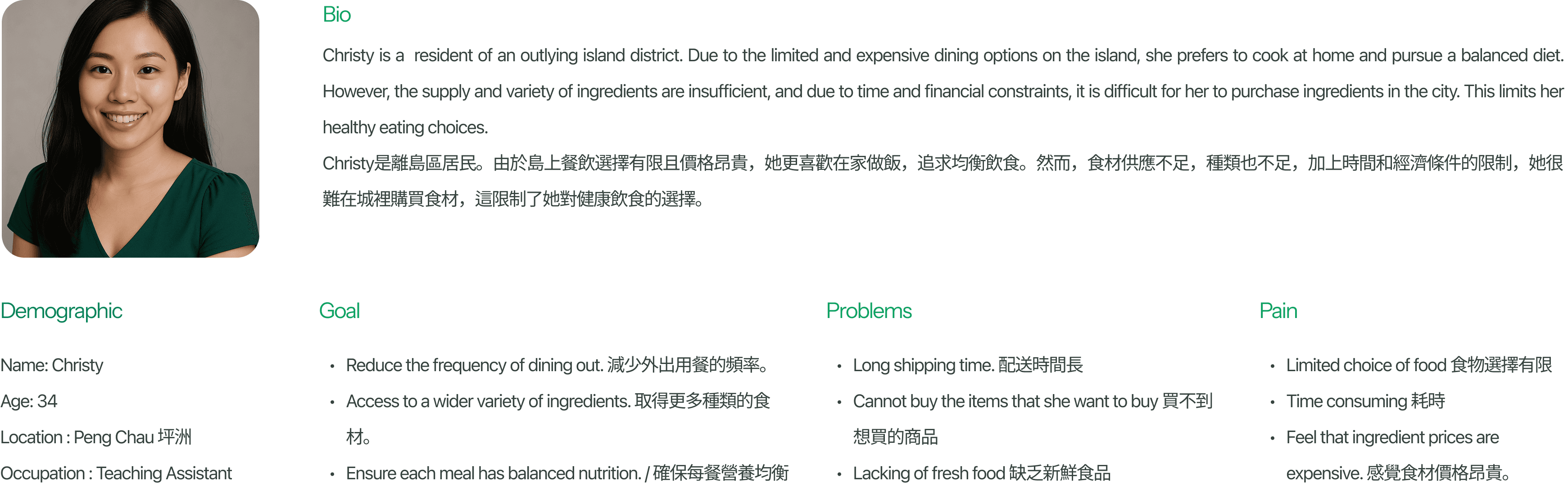
Fresh food is hard to access consistently
Residents often said that the food they wanted was not always available on the island. Even when basic items were available, the range of fresh ingredients was limited, which made it harder to cook balanced meals at home.
Shopping outside the island is possible, but not always practical
Travelling to the city may offer more choices, but it also introduces ferry fares, longer travel time, and more effort. In many cases, the cost of leaving the island reduced the benefit of the trip.
Health pursuit
Many interviewees also told us they valued healthy eating and tried to maintain a balanced diet. Some used supplements to support their well-being. However, good intentions did not fully solve the problem when fresh ingredients were difficult to buy regularly.
Persona
Design Principles
Improve accessibility
The service should make it easier for residents to find and receive the food and health-related products they need.
Reduce travel burdens
The service should reduce the need for residents to spend extra time and money travelling off the island for better food options.
Support healthier choices
The service should not only improve access, but also help users make healthier decisions with less effort.
Design Concept
Research insights shaped every feature — here is how each connects back to a user pain point.
Online Marketplace
Urban market inventory delivered by SF Express drone to island cold-chain lockers within 48 hours. This turns the location barrier from our research into the service's core value and primary revenue driver.


Personalized nutrition test
Users enter goals and body metrics to receive tailored diet plans and recipes. Designed as a retention hook: personalized results give users a reason to return and track progress over time.
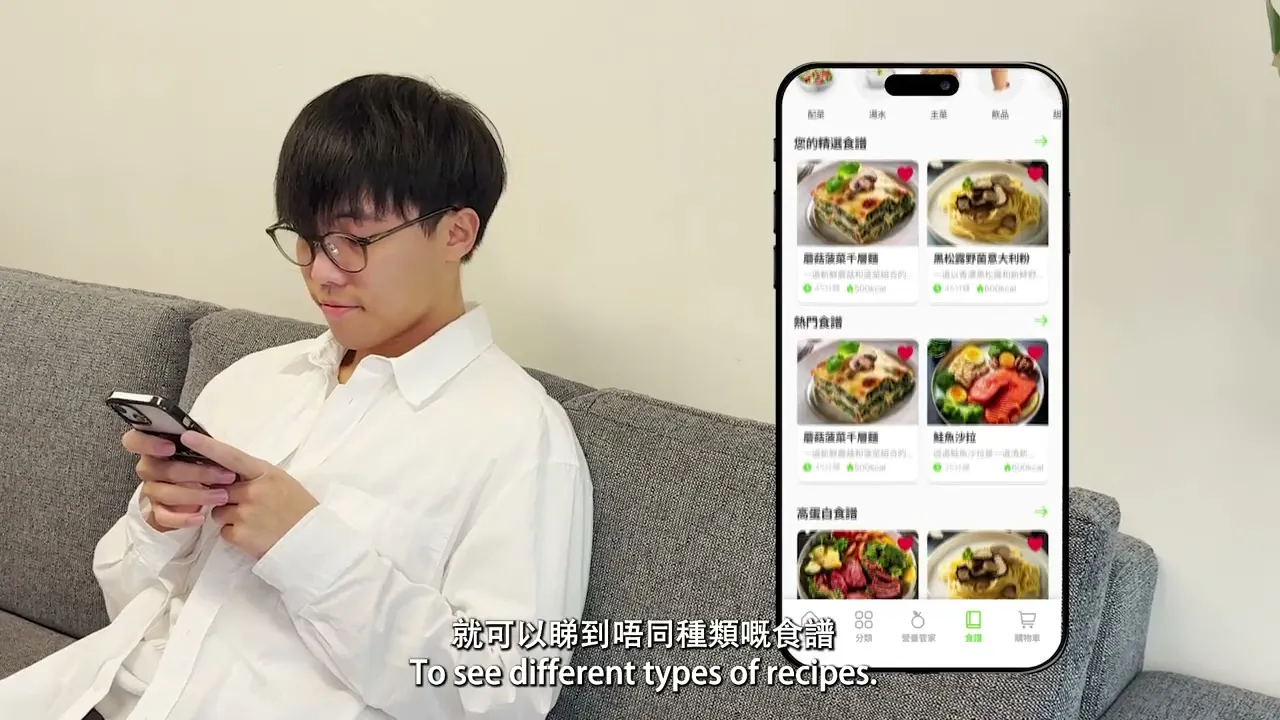
Healthy Recipe
Recipes with detailed nutrition info and pre-packaged ingredient sets. These provide actionable guidance from test results, closing the loop between dietary goals and practical daily meals.


Nutrition Tracker
Daily food intake logging with goal comparison and ongoing recommendations. Together with recipes, it transforms a single grocery purchase into an ongoing health partnership that drives retention.
Demo Video
Reflection

Research shapes the concept, not the other way around
This was my first project working inside a real business constraint — SF Express’s drone delivery infrastructure was fixed, and I had to design around it. I learned that serving users and fulfilling business requirements are not the same thing, and the trickiest part is finding where they overlap. That tension between user needs and business viability is now something I look for explicitly in every project I take on.